


How net zero affects industrial real estate is becoming an increasingly important topic as sustainability reshapes building design, energy use, and operating costs.
Join KTG Industrial to explore how this trend is transforming the industrial real estate sector and creating new opportunities for green industrial spaces.
Why is net zero changing the industrial real estate market?
Net zero is directly affecting the industrial real estate market as emissions regulations and ESG commitments increasingly influence corporate investment, production, and site selection decisions.
Climate policies, expectations from multinational corporations, and sustainable development trends are driving demand for factories and warehouses that meet green building standards.
From 2026, the EU Carbon Border Adjustment Mechanism (CBAM) enters its definitive phase for goods within its scope. The mechanism requires importers to declare embedded emissions and fulfill obligations related to CBAM certificates.
At the same time, the Corporate Sustainability Reporting Directive (CSRD) requires environmental disclosures from companies within its scope. These regulations increase pressure to control emissions across supply chains, driving demand for energy-efficient and low-carbon industrial facilities [1].
Corporations such as Amazon, DHL and Unilever are promoting emissions reductions across their supply chains through targets for clean energy use and operational optimization.
Amazon invests in renewable energy at logistics centers [2], while DHL is expanding solar power and energy-efficient technologies across its warehouses [3].
These initiatives are raising the bar for the industrial facilities used by their partners and suppliers.
The market is seeing a distinction between green-certified warehouses such as LEED-certified facilities and traditional warehouses. Facilities equipped with energy-saving systems, renewable electricity, and efficient operational management are better positioned to meet the ESG requirements of international tenants. Meanwhile, traditional warehouses may incur additional upgrade costs to remain competitive.

Net zero is reshaping the criteria for selecting factories, warehouses, and industrial real estate
What does net zero mean for an industrial facility?
Operational carbon vs. embodied carbon
Operational carbon comes from the energy consumed during a facility’s operation, such as electricity used for lighting, air conditioning, and equipment.
Embodied carbon comes from the production of materials, construction, maintenance, and demolition of a facility.
In general, the developer is primarily responsible for material selection and construction solutions, while the tenant directly controls most of the energy consumed in business operations.
However, actual responsibilities also depend on the lease agreement, electricity payment arrangements, and the scope of each company’s emissions reporting.
Key green building certification and assessment systems
| Certification | Key characteristics |
| LEED | Assesses buildings based on energy efficiency, water use, materials, and indoor environmental quality. |
| BREEAM | Assesses sustainability across multiple aspects, including energy, materials, transport, water, and building management [4]. |
| EDGE | Focuses on energy and water savings, as well as embodied energy in materials [5]. |
| NABERS | Measures actual operational performance, including energy, water, waste, and indoor environment [6]. |
The certifications above have different assessment scopes and do not necessarily mean that a facility has achieved net zero. Businesses should consider the specific criteria and certification results when selecting factories and warehouses.
What does a warehouse or factory designed to support net-zero goals look like in practice?
A warehouse or factory designed with a net zero target typically integrates energy-efficient solutions and clean electricity from the design stage:
- Rooftop solar panels and battery storage systems use rooftop space to generate electricity and store excess energy for flexible use.
- LED lighting and BMS: Reduce lighting energy consumption and enable automated control and monitoring of building systems and equipment.
- Insulation and high-efficiency HVAC: Limits heat loss and optimizes ventilation and air conditioning systems.
- Electric vehicle (EV) charging infrastructure: Supports the adoption of electric vehicles and can be integrated with energy management systems to optimize charging schedules and energy use.
Rooftop solar, LED lighting, and EV charging stations are practical solutions already being implemented at warehouses and distribution centers to improve energy efficiency and reduce emissions.
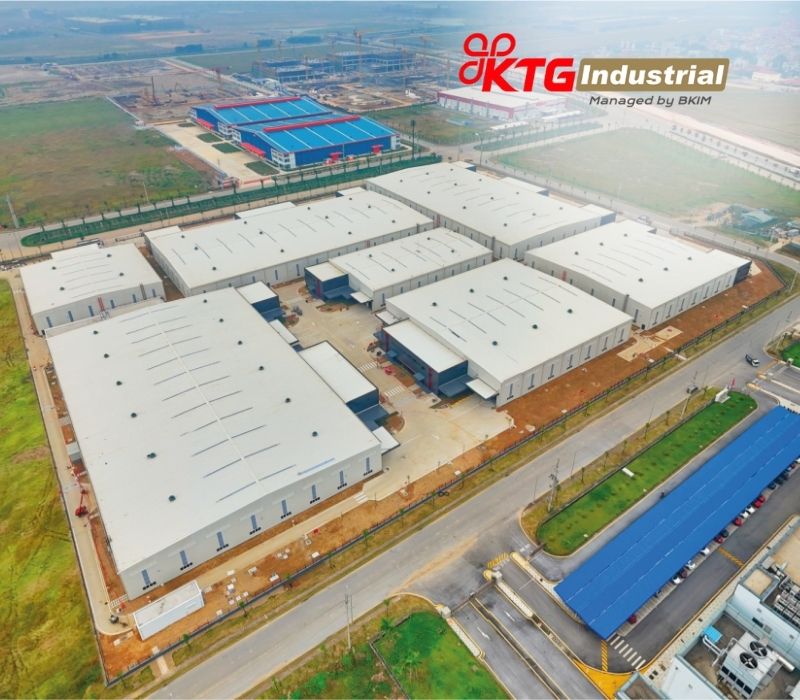
KTG Industrial VSIP Bac Ninh II integrates green solutions, supporting efficient operations and emissions reduction for tenants
Impact on rental and operating costs
Green premium
According to a 2024 CBRE report, sustainability-certified office buildings in Europe had average rents 4.9% higher than non-certified buildings [7]. However, this figure comes from the office market and cannot be directly applied to warehouses or factories.
Therefore, the green premium should be assessed based on each market, location, building standard, and leasing demand rather than applying a fixed rate.
Reducing operating costs
Energy-efficient industrial facilities can help businesses reduce operating costs. According to PNNL’s warehouse design guidance, optimized solutions can help small warehouses save 30% in energy compared with the ASHRAE 90.1-1999 standard [8]. Actual savings depend on the design, equipment, and energy-use intensity of each facility.
The actual financial benefits also depend on electricity prices, operating intensity, upfront investment costs, and the extent to which renewable energy systems can be utilized. These factors should be considered when comparing rental costs between green facilities and traditional warehouses.
Key considerations tenants cannot overlook
Supply chain requirements
Large corporations are incorporating emissions reduction targets into requirements for suppliers and logistics partners. Businesses leasing warehouses and factories need to assess whether a facility can meet environmental standards from the site selection stage, rather than considering only floor area and rental costs.

Green standards are becoming more embedded in supply chains, directly affecting businesses’ warehouse and factory selection
Carbon Border Adjustment Mechanism (CBAM)
From 2026, the EU’s CBAM applies to certain groups of goods, including iron and steel, aluminum, cement, fertilizers, electricity, and hydrogen. Importers must declare embedded emissions and purchase corresponding CBAM certificates [1].
As a result, goods with high emissions intensity may incur higher costs when entering the EU market.
Energy and emissions reporting requirements
Many markets have introduced mandatory energy and emissions reporting mechanisms for businesses or facilities within their scope.
In the UK, SECR requires eligible businesses to disclose energy and emissions information in their annual reports [9]. Singapore also requires facilities emitting 2,000 tonnes of CO₂e or more to submit annual emissions reports [10].
Therefore, tenants need to clearly determine whether reporting obligations fall on the developer, operator, or tenant before signing a lease.
Contractual responsibilities
Green leases may require tenants to provide energy consumption data, maintain operational performance, or cooperate in achieving emissions reduction targets.
Therefore, provisions concerning energy, ESG data, and operating standards should be reviewed alongside rental costs and lease terms.
Stranded asset risks for tenants
A “brown discount” can be understood as a discount applied to assets with poor environmental performance, reflecting the risk of declining asset value due to upgrade costs or the inability to meet new standards.
CBRE notes that assets whose carbon performance fails to keep pace with decarbonization pathways may become “stranded assets”, meaning assets at risk of losing value or becoming less viable to operate [11].
For tenants, this risk may arise when energy standards change during the lease term. In such cases, businesses may need to coordinate with the developer to upgrade the facility or consider alternative leasing options, depending on the terms of the contract.
Renovation costs therefore also become a factor to consider when evaluating an asset.
Criteria for evaluating industrial real estate designed to support net-zero goals
Checklist for tenants
Rather than looking only at green certifications, businesses can assess operational performance, energy sources, and contractual responsibilities at the same time.
- Green certifications: Does the facility hold a valid certification such as LEED Gold/Platinum or BREEAM Excellent or higher?
- Renewable energy: Does the facility have on-site solar power or a verifiable renewable electricity source?
- Energy efficiency: What is the facility’s EPC (Energy Performance Certificate) rating or energy-use intensity?
- EV infrastructure: Are electric vehicle charging points available, or is there a specific deployment plan?
- Green lease: What data must the tenant provide, and what emissions reduction obligations must the tenant fulfill?
- Net zero roadmap: Has the developer disclosed specific targets, timelines, and plans to upgrade the facility?
These criteria should be used as an initial due diligence checklist rather than assuming that a facility with a green certification has already achieved net zero.
KTG Industrial: Warehouse and factory solutions supporting sustainable development requirements
KTG Industrial develops ready-built warehouses and build-to-suit factories designed to meet the operational needs of businesses as environmental standards receive increasing attention.
The projects integrate solutions that support efficient energy use, optimize operations, and aim to reduce environmental impacts throughout the facility’s lifecycle.
With a focus on sustainable industrial real estate development, KTG Industrial provides production and logistics space suited to businesses considering green standards, supply chain requirements, and emissions reduction pathways.
This can be one of the factors businesses consider when selecting warehouse and factory locations as part of their long-term development plans.
Conclusion
For tenants, facilities designed to support net-zero goals can help manage energy consumption, reduce risks associated with evolving environmental requirements during the lease term, and better meet the standards set by international customers and partners.
These benefits can directly affect operational efficiency and a business’s competitiveness.
References
[1] European Commission (2026). CBAM definitive regime.
https://taxation-customs.ec.europa.eu/carbon-border-adjustment-mechanism/cbam-definitive-regime_en
[2] Amazon. Buildings.
https://sustainability.aboutamazon.com/climate-solutions/buildings
[3] DHL Group. Building decarbonization.
https://group.dhl.com/en/sustainability/environment/building-decarbonization.html
[4] BREEAM (2026). GN24 Demonstrating compliance with responsible sourcing requirements in BREEAM.
GN24 Demonstrating compliance with responsible sourcing requirements in BREEAM
[5] EDGE (2023). EDGE basics.
https://support.usgbc.org/hc/en-us/articles/4522583244435-EDGE-basics
[6] NABERS. What is NABERS?.
https://www.nabers.gov.au/about/what-nabers
[7] CBRE (2024). Is Sustainability Certification in Real Estate Worth it?
https://www.cbre.com/insights/reports/is-sustainability-certification-in-real-estate-worth-it-2024
[8] Liu B., R.E. Jarnagin, W. Jiang, and K. Gowri (2007). Technical Support Document: The Development of the Advanced Energy Design Guide for Small Warehouse and Self-Storage Buildings. Richland, WA: Pacific Northwest National Laboratory.
https://www.pnnl.gov/publications/technical-support-document-development-advanced-energy-design-guide-small-warehouse
[9] Regulatory Policy Committee. (2026, June 8). RPC opinion: SECR PIR. GOV.UK.
https://www.gov.uk/government/publications/rpc-opinion-the-companies-directors-report-and-limited-liability-partnerships-energy-and-carbon-report-regulations-2018-pir/rpc-opinion-secr-pir
[10] National Environment Agency. Measurement and reporting requirements for greenhouse gas emissions.
https://www.nea.gov.sg/our-services/climate-change-energy-efficiency/climate-change/carbon-tax/measurement-and-reporting-requirements-for-greenhouse-gas-emissions
[11] Forcellati, C. (2026). The century paradox: Why the built environment is mortgaging its future. CBRE.
https://www.cbre.com/insights/articles/the-century-paradox-why-the-built-environment-is-mortgaging-its-future