


Vietnam continued to attract international investors in the first 9 months of 2026, reflecting the market’s potential as businesses stepped up manufacturing expansion and supply chain diversification.
Alongside this trend, greater emphasis is being placed on manufacturing infrastructure, logistics and supply chain connectivity. For investors, site selection depends not only on location and costs but also on operational readiness and the ability to support long-term development plans.
Overview of Vietnam’s FDI performance in the first 9 months of 2026
Registered and disbursed FDI reach notable milestones
According to the National Statistics Office, total registered FDI in Vietnam reached USD 50.36 billion as of September 30, 2026, up 76.4% year-on-year. Meanwhile, disbursed FDI reached USD 21.07 billion, up 12.1% and marking the highest level for the first 9 months of the year in the past 5 years [1].
For the manufacturing sector, the pace of capital deployment directly affects factory construction schedules, production line installation, workforce recruitment and supplier network development.
Demand for industrial space depends not only on the number of new projects but also on implementation timelines and expansion plans among existing investors.
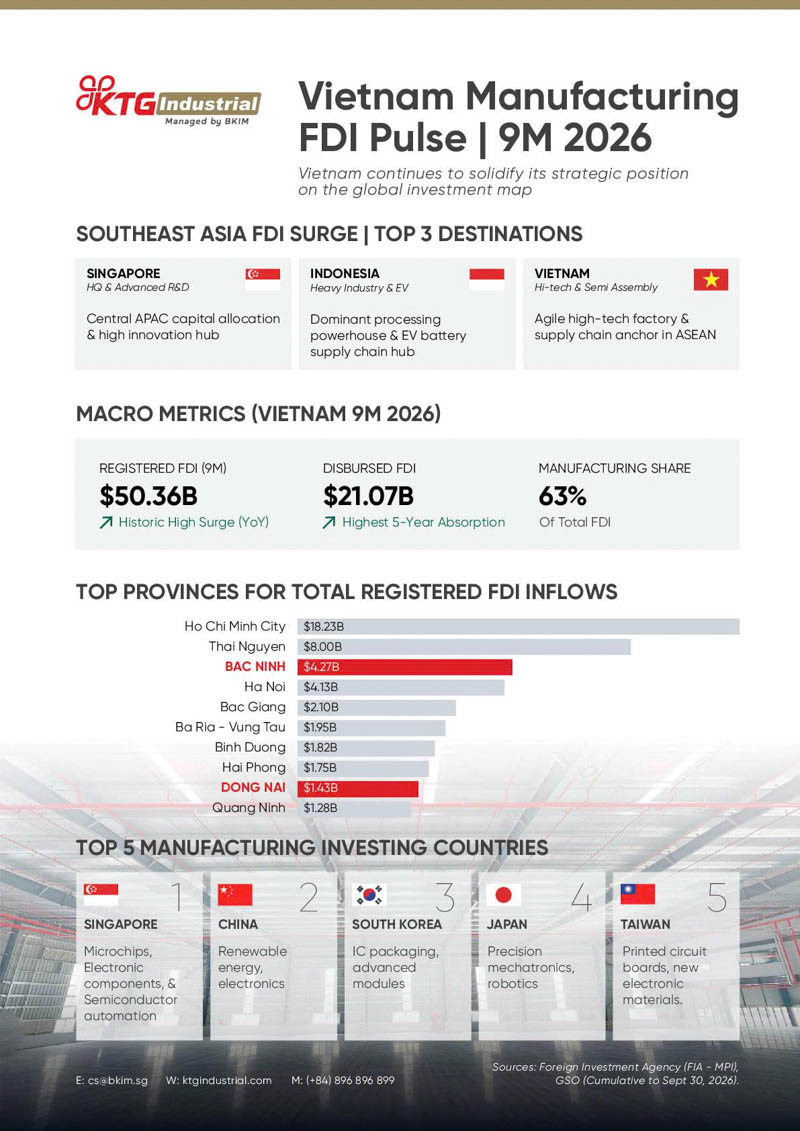
Overview of FDI attraction in Vietnam’s manufacturing sector in the first 9 months of 2026
Manufacturing continues to play a leading role
Manufacturing and processing continued to attract the largest share of FDI. According to data from the National Statistics Office published by the Government Portal, the sector received USD 13.38 billion in newly registered capital in the first 9 months of the year, accounting for 45.8% of total newly registered capital [1].
This proportion indicates that manufacturing continues to play an important role in attracting foreign investment to Vietnam.
The presence of manufacturing projects also generates demand for factory facilities, warehouses, power infrastructure, water treatment systems and logistics services.
For industries with high technical requirements, investors must also assess whether facilities are suitable for their machinery, production lines and operational requirements.
Vietnam’s transformation in regional industrial investment strategies
From “China+1” to an interconnected Asian manufacturing hub
Vietnam is becoming more deeply integrated into global manufacturing networks, supported by its connectivity to major markets, workforce and industrial park system.
While the “China+1” model previously served as Vietnam’s primary advantage in attracting investment, the country is now evolving into a “Clustered-Asia” market, where interconnected manufacturing clusters and investment networks converge across Asia. This shift is attracting substantial FDI from leading developed economies, including Singapore, China, South Korea, Japan and Taiwan.
With a focus on semiconductors, electronic components, renewable energy and precision manufacturing, Vietnam has moved beyond its traditional role as a simple transshipment hub to become a strategic operational link in regional supply chains.
New criteria for manufacturing site selection
This shift is also changing the evaluation criteria used by modern multinational investors.
When choosing between undeveloped industrial land and ready-built factories (RBF), businesses are increasingly considering factors that extend well beyond traditional cost calculations.
Today’s market demands a comprehensive ecosystem and solutions that are ready for operation, shaped by the following factors:
Streamlined administrative procedures: Accelerating licensing processes, the issuance of Investment Registration Certificates (IRC) and Enterprise Registration Certificates (ERC), thereby shortening project implementation timelines and bringing manufacturing operations online sooner.
Resilient infrastructure: Stable power grids, backup power supply plans and clear green transition roadmaps to meet environmental, social and governance (ESG) standards. A notable example is KTG Industrial VSIP Bac Ninh II in Bac Ninh, a project that has achieved LEED Gold certification in line with its green building development approach.
Integrated ecosystem: A well-developed domestic supporting industry network, a skilled workforce with structured training and interconnected supply chain clusters.
Bac Ninh and Dong Nai: Two key industrial manufacturing locations
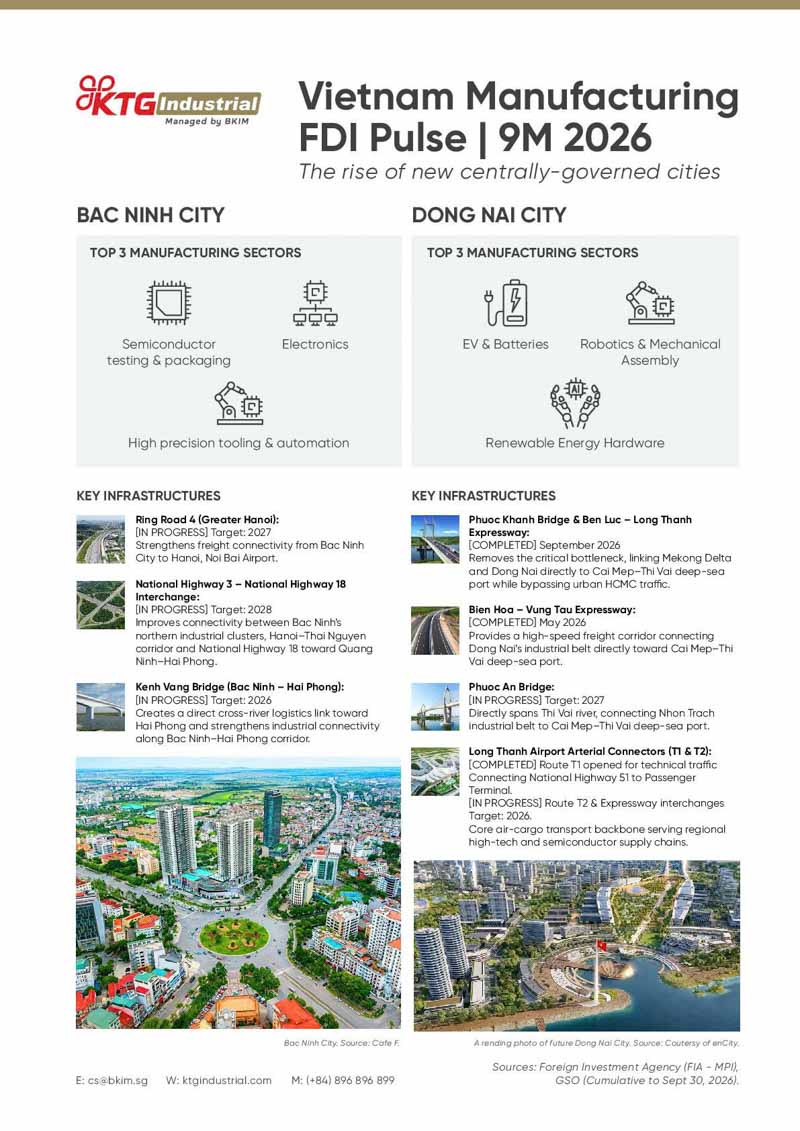
Key manufacturing sectors and connectivity infrastructure in Bac Ninh and Dong Nai during the first 9 months of 2026.
Bac Ninh focuses on semiconductors and electronics
Bac Ninh is one of the key industrial manufacturing locations in northern Vietnam, benefiting from connectivity to Hanoi, Noi Bai International Airport and neighboring industrial parks. Its manufacturing ecosystem supports various activities across the electronics supply chain, from component assembly to specialized technical processes.
Key manufacturing sectors: Bac Ninh focuses on semiconductor testing and packaging, electronics, precision instruments and automation.
These sectors have stringent requirements for infrastructure reliability, equipment layout and operating environment quality. However, the presence and investment scale of each sector should be verified against specific data or project information.
Regional connectivity infrastructure: Interregional transport infrastructure is undergoing investment and upgrades, helping improve Bac Ninh’s connectivity with Hanoi and industrial and logistics hubs across northern Vietnam.
Among these projects, Ring Road 4 of the Hanoi Capital Region is expected to strengthen links between Bac Ninh, Hanoi and neighboring localities, providing additional options for freight transportation and connecting industrial parks to the regional transport network. The project is targeted for completion in 2027.
Projects involving National Highway 3 and the National Highway 18 interchange are underway, with completion targeted for 2028. Once completed, these developments are expected to improve connectivity between industrial clusters in northern Bac Ninh and the Hanoi–Thai Nguyen corridor, as well as National Highway 18 toward Quang Ninh and Hai Phong.
Kenh Vang Bridge, targeted for completion in 2026, is another notable project in the interregional transport network. Improved river crossings could facilitate movement between Bac Ninh and neighboring localities while expanding connectivity options to transport corridors leading toward Hai Phong.
Once these projects are completed and operational, more integrated connectivity could enhance flexibility in supply chain management for manufacturers in Bac Ninh.
Ready-built factory solutions: Given the specific requirements of the electronics and semiconductor industries, factory selection should be based on the facility’s ability to accommodate production space requirements, equipment layouts and technical infrastructure. Specifications such as factory height, floor loading capacity and power supply capacity also provide a basis for assessing whether a facility is suitable for operational plans.
In Bac Ninh, KTG Industrial VSIP Bac Ninh II Phase 1 offers leasable areas ranging from 1,360 to 43,892 m², including office space. The factories have a clear height of 8.7 m, a floor loading capacity of 2 tons/m² and a power supply capacity of 100 W/m², providing a basis for businesses to assess equipment installation, machinery layout and space planning in line with operational needs.
In addition to these core specifications, the project is equipped with a comprehensive fire protection system, including fire hydrants, fire hose reels, water sprinklers, fire alarms and smoke extraction systems.
The floors feature power-troweled concrete with a surface hardener, while the roofs use aluminum-zinc alloy-coated steel sheets combined with bubble insulation.
Notably, LEED Gold certification highlights the project’s green building approach, providing an additional criterion for businesses to consider when selecting a manufacturing location.
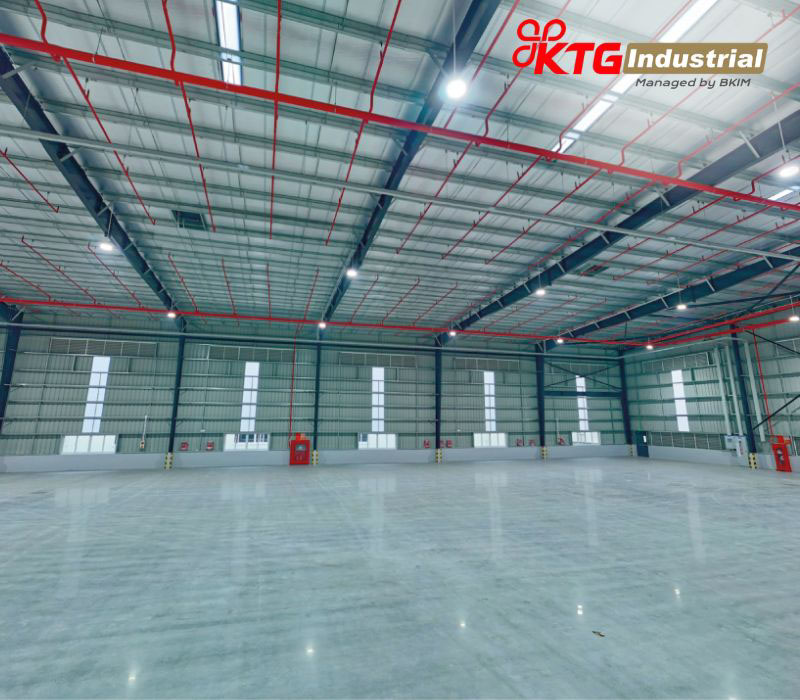
Inside the KTG Industrial VSIP Bac Ninh II Phase 1 factory
Dong Nai focuses on electric vehicles, mechanical engineering and renewable energy
Dong Nai is a key industrial location in southern Vietnam, benefiting from connectivity to manufacturing centers, logistics hubs and seaports. Its industrial ecosystem has the potential to support various manufacturing sectors, from electric vehicle equipment and batteries to precision engineering and automated assembly.
Key manufacturing sectors: Dong Nai focuses on three industry groups: electric vehicles and batteries, robotics and mechanical assembly, and renewable energy hardware.
These sectors require production facilities suited to machinery lines, specialized equipment and specific operating processes. For businesses in the electric vehicle, mechanical engineering and energy supply chains, access to transport infrastructure and logistics hubs is also an important consideration when selecting an investment location.
Regional connectivity infrastructure: Dong Nai’s transport network is being developed to strengthen connections between industrial parks, logistics centers and seaports in southern Vietnam.
The Ben Luc–Long Thanh Expressway and Phuoc Khanh Bridge were completed in September 2026, helping establish an interregional connection between the Mekong Delta, Ho Chi Minh City and Dong Nai.
The Bien Hoa–Vung Tau Expressway, listed as completed in May 2026 in the infographic, adds a transport corridor from Dong Nai’s industrial areas toward the deep-water Cai Mep–Thi Vai Port.
Meanwhile, Phuoc An Bridge is under construction, with completion targeted for 2027, to strengthen connectivity between the Nhon Trach industrial area and Cai Mep–Thi Vai Port.
The road network connecting to Long Thanh International Airport is also being completed. Route T1 has opened for technical traffic, while Route T2 and the interchanges connecting to the expressways are under development.
Once these infrastructure projects are fully integrated, manufacturers will have additional options for organizing freight transportation between industrial parks, logistics centers and key transport hubs across the region.
Ready-built factory solutions: For businesses in the electric vehicle, mechanical engineering and renewable energy sectors, factories need sufficient space for machinery, equipment and production line layouts. Factors such as usable area, clear height, floor loading capacity and power supply capacity help businesses make an initial assessment of whether a facility can meet their actual operational requirements.
KTG Industrial Nhon Trach 2 (Phase 4) is an option worth considering for businesses seeking ready-built factories in Dong Nai. The project covers a total area of 18.69 ha and has been developed across 4 phases.
The project offers two-storey factories with flexible floor areas. The first floor ranges from 3,035 to 13,800 m², while the second floor ranges from 1,577 to 14,041 m².
The published clear heights are 8 m on the first floor and 7 m on the second floor, combined with a floor loading capacity of 2 tons/m² and a power supply capacity of 100 W/m². These specifications help businesses make an initial assessment of equipment installation, machinery layout and production space planning based on their operational needs.
In terms of technical infrastructure, the factories feature reinforced concrete floors finished with a surface hardener to help limit dust and surface cracking. The project is also equipped with a fire protection system, including fire hoses, sprinklers, fire alarms and smoke extraction systems.
Beyond the physical facilities, the location in Nhon Trach and access to labor from neighboring areas are additional factors businesses can consider when selecting a manufacturing site.
Conclusion
Vietnam’s ability to attract FDI in the coming period will depend on its business environment, infrastructure quality and capacity to meet manufacturers’ operational requirements.
Choosing a suitable factory is an important component of a long-term investment strategy. Businesses can explore ready-built factory solutions at KTG Industrial to identify locations that align with their operational needs.
References
[1] Cong Thong tin dien tu Chinh phu (2026). Von FDI thuc hien 9 thang dat hon 21 ty USD, cao nhat cung ky 5 nam qua. Bao Chinh phu.
https://baochinhphu.vn/von-fdi-thuc-hien-9-thang-dat-hon-21-ti-usd-cao-nhat-cung-ky-5-nam-qua-102261003103902217.htm