


Leasing land in an industrial park is a critical decision that affects an enterprise’s long-term operational and financial strategy.
Among the available options, the one-time payment model has attracted significant interest from investors due to its legal stability and clear asset usage rights.
The following article, compiled by KTG Industrial, explains the concept, benefits, and key considerations of applying this leasing model in Vietnam.
Concept: What is a one-time payment industrial land lease?
According to the 2013 Land Law (amended in 2023) and Decree 135/2016/ND-CP, a one-time payment industrial land lease is a model in which an enterprise fulfills its full financial obligations at the moment of signing the lease contract.
This payment covers the entire lease term, typically 50 years, depending on local policies.
Unlike annual payment schemes, the one-time payment option provides cost stability and facilitates collateral, transfer, or assignment of land use rights. However, this choice requires strong financial capacity and a long-term operational strategy.
Currently, both payment methods are applied depending on agreements with infrastructure developers or the state. Enterprises need to carefully evaluate which option aligns with their scale and development plans.
Key advantages of one-time payment leases
Stable land use rights over the long term
Paying the lease in full ensures that the enterprise has stable land use rights for the entire lease term.
This allows investors to plan long-term production and business activities without worrying about interruptions or renewal procedures. This advantage is particularly suitable for projects with long operational timelines or high capital requirements.
Fixed lease cost, avoiding cost volatility risks
By paying the full lease amount upfront, enterprises fix their land rental costs for the entire term. This protects them from risks associated with inflation or future adjustments to rental rates under state policies.

Fixed lease costs are especially beneficial when industrial land prices are rising rapidly
Can be used as collateral or transferred as an asset attached to the land
One-time payment leases usually come with stable land use rights, allowing enterprises to treat the land as a secured asset. This facilitates collateral arrangements with banks or capital raising from investors.
At the same time, the transfer or contribution of land use rights as capital becomes more flexible and transparent.
Convenient for large-scale, long-term projects
With guaranteed land use rights throughout the project lifecycle, enterprises can confidently implement long-term investment plans.
This model is particularly suitable for sectors requiring stable infrastructure, high capital investment, and long payback periods, such as industrial manufacturing, logistics, or high-tech industries.
Some disadvantages to consider
High initial capital requirement
Enterprises must have sufficient financial resources to pay the full land lease cost upfront. This can reduce cash flow flexibility, especially for small to medium-sized investors or newly established projects.
Risk if business direction changes
If business strategies are adjusted or the market fluctuates, enterprises may face difficulties after committing long-term to a fixed land plot.
Changing production locations or restructuring is not as easy or flexible as with annual lease payments.
Difficulty recovering capital if the project underperforms
A one-time investment in land use rights makes it challenging to quickly recover capital if the project does not achieve expected results.
Transfer or liquidation of land use rights depends on factors such as legal conditions, market demand, and approval from authorities.
Need to understand legal regulations to avoid disputes over term and land use rights
This lease model requires enterprises to carefully study relevant legal regulations to protect their interests. Misunderstanding lease terms, transfer conditions, or financial obligations can lead to potential legal disputes in the future.
Rights and obligations of enterprises under a one-time payment land lease
Rights guaranteed during the lease term
Throughout the lease term, enterprises are ensured stable land use rights for the duration specified in the contract, typically 50 years or more.
As long as enterprises fulfill their financial and legal obligations, their land use rights will not be interrupted or revoked.
Additionally, enterprises are protected in their legal ownership of assets attached to the land, such as factories and machinery. This right facilitates long-term investment and the implementation of sustainable production plans.
In cases where the state reclaims land for public purposes, enterprises may be considered for support or compensation in accordance with regulations.
Obligations to pay taxes, fees, comply with planning, and uphold investment commitments
Enterprises are responsible for fulfilling all financial obligations, including land use taxes, environmental protection fees, and other related charges.
Furthermore, the construction and operation of projects must comply with approved land-use plans and initial investment commitments.
If adjustments to the original plan are necessary, enterprises must follow legal procedures to avoid disputes.
Enterprises are also required to adhere to regulations on fire safety, labor safety, and environmental protection.
Mechanism for adjustments in land use purpose or transfer
If an enterprise wishes to adjust the land use purpose, transfer the project, or assign land use rights to a third party, it must obtain approval from the competent authorities.
Any adjustment to the land use purpose must align with the approved planning and comply with current legal regulations.
For transfers, the enterprise must complete all financial obligations and possess all necessary legal documents related to the land use rights.
In some cases, approval from the industrial park management board or the provincial People’s Committee may also be required.

The law allows flexible transfers, but following the proper procedures is essential to avoid risks
Procedures and implementation process
Legal documents to prepare
Before engaging with the industrial park management board or relevant authorities, enterprises must prepare all required legal documents. Mandatory documents include:
- Application for one-time payment industrial land lease
- Business registration certificate
- Investment policy approval document
- Investment project dossier and financial capability documents
Additionally, in some cases, an environmental impact assessment report or a planning appraisal document may be required.
Process for working with the industrial park management board
After completing the documentation, the enterprise will work directly with the industrial park management board for procedural guidance. The first step is to submit the documents and receive a receipt.
Next, the management board will coordinate with relevant departments to assess land use needs and the enterprise’s capacity to implement the project.
If the documents meet the requirements, the management board will forward them to the provincial People’s Committee to issue a land lease decision.
Once the decision is issued, both parties will sign the lease contract and carry out the payment procedures for land use rights.
Throughout this process, enterprises need to actively monitor progress and closely coordinate with authorities to ensure timely completion.
Processing time and practical considerations for implementation
The processing time for industrial land lease procedures depends on the locality, type of land, and legal status of the industrial park.
Enterprises must prepare complete legal documentation and closely coordinate with the industrial park management board to avoid delays.
Practical considerations when implementing:
- Engage early with the industrial park management board to confirm the current payment methods in each locality, as each industrial park may apply different land lease policies.
- Maintain close communication with relevant departments such as the Department of Natural Resources and Environment, the Department of Planning and Investment, or the Land Registration Office to monitor progress and address any issues promptly.
- Pay attention to long-term land use planning and investment commitments in the lease contract, as one-time payment leases are typically associated with long-term land use (up to 50 years). Changing land use objectives mid-term may require complex adjustment procedures.
- Stay updated on new legal regulations related to the 2024 Land Law and guiding documents, especially as policies regarding the conversion of land lease forms are under review.
KTG Industrial – Industrial park warehouse provider
As a reputable player in Vietnam’s industrial real estate sector, KTG Industrial offers flexible options for investors.
Its projects are present in major industrial parks such as VSIP Bac Ninh II and Yen Phong, and are developed in line with global environmental and sustainable development standards like LEED and ESG.
This approach helps investors save time, control costs effectively, and strengthen their reputation in the international supply chain.
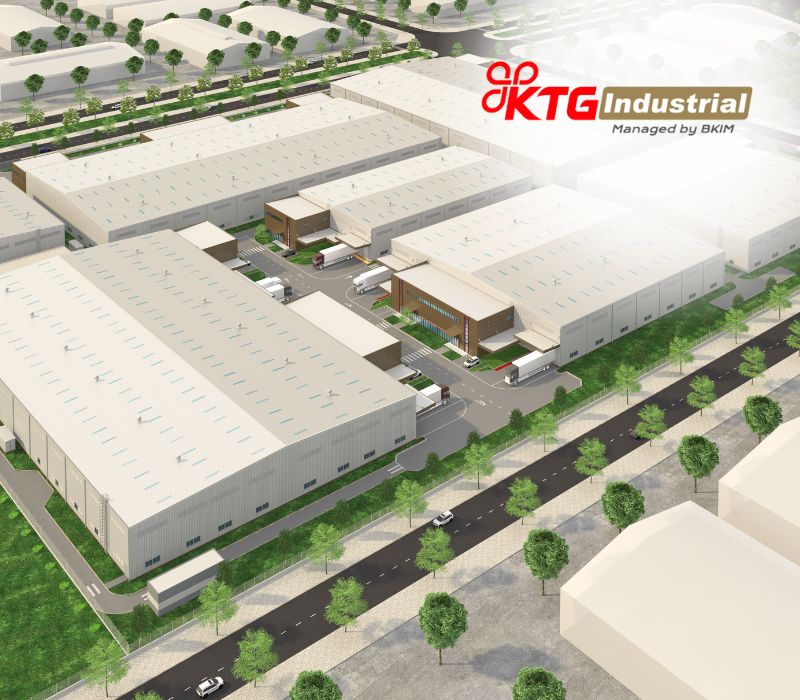
KTG Industrial VSIP Bac Ninh II
Conclusion
One-time payment industrial land leases are considered by many enterprises due to their long-term stability, clear land use rights, and potential for optimizing costs over time.
However, to ensure investment efficiency, investors must thoroughly understand the legal procedures, select a suitable industrial park, and collaborate with a reputable developer.
This choice is not only a financial decision but also a long-term strategy for sustainable business growth in an increasingly competitive industrial environment.