

The Vietnam industrial zone map illustrates the development of manufacturing hubs along key economic corridors, closely connected to transportation networks, seaports, and major economic regions. From industrial provinces in the north to the central coastal region and the southern key economic region, each area has distinct characteristics in terms of industries, scale, and connectivity advantages.
Northern Vietnam stands out for its electronics manufacturing and supporting industries, while central Vietnam offers development potential thanks to its available land and seaport infrastructure. Southern Vietnam maintains its position as an industrial and logistics hub, with a high concentration of industrial parks and strong connections to Ho Chi Minh City and major import-export gateways.
Differences in location and infrastructure make an industrial zone map an important reference tool for businesses seeking manufacturing sites. The overview map of industrial parks in Vietnam below helps investors identify potential locations and compare regional advantages before making decisions.
Overview of Vietnam’s industrial park system
As of the end of 2025, Vietnam had 478 established industrial parks, of which 324 were operational and 153 were under construction. The total planned natural land area reached approximately 146,000 hectares, providing more than 101,600 hectares of industrial land [1].
This supply is unevenly distributed across the three regions, with major industrial hubs concentrated around important economic, transportation, and logistics gateways.
By region, northern Vietnam focuses on electronics manufacturing and supporting industries. Central Vietnam offers room for development thanks to its available land and seaport advantages, while southern Vietnam has an industrial and logistics network connected to major economic centers.
The occupancy rate of operational industrial parks nationwide stood at approximately 75%. In key northern industrial provinces, the rate was around 83%, while the southern region reached approximately 92%, highlighting differences in supply pressure across regions [2].
Regarding FDI inflows, manufacturing and processing remained the leading sector for foreign investment in 2025, attracting approximately USD 21 billion, equivalent to 54.7% of total registered FDI. By locality, Ho Chi Minh City, Bac Ninh, and Hai Phong were among the leading destinations for cumulative registered FDI [3].
These areas also have well-developed industrial park networks and strong connections to seaports, airports, and supply chains, sustaining demand for industrial land and factory space.
Vietnam industrial zone map
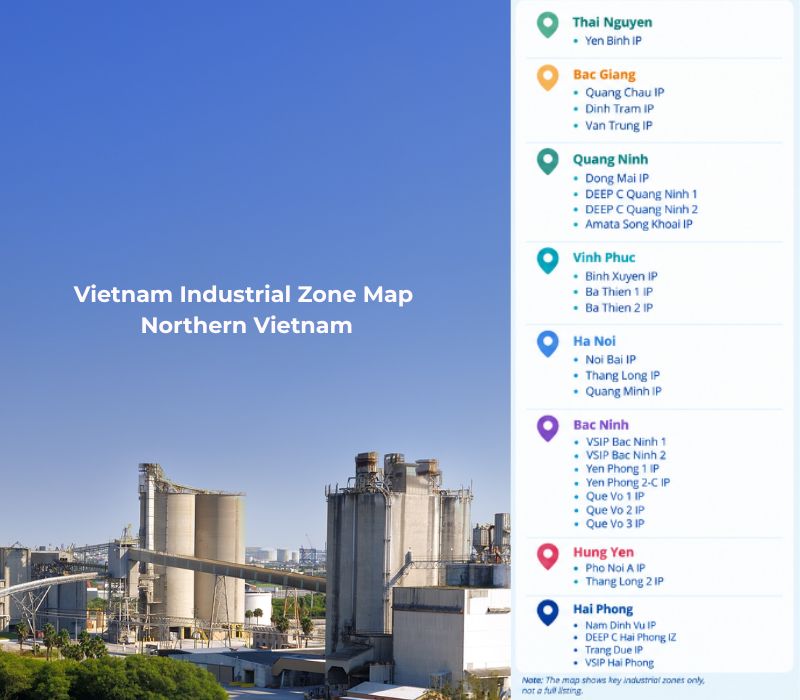
Vietnam industrial zone map: Northern Vietnam
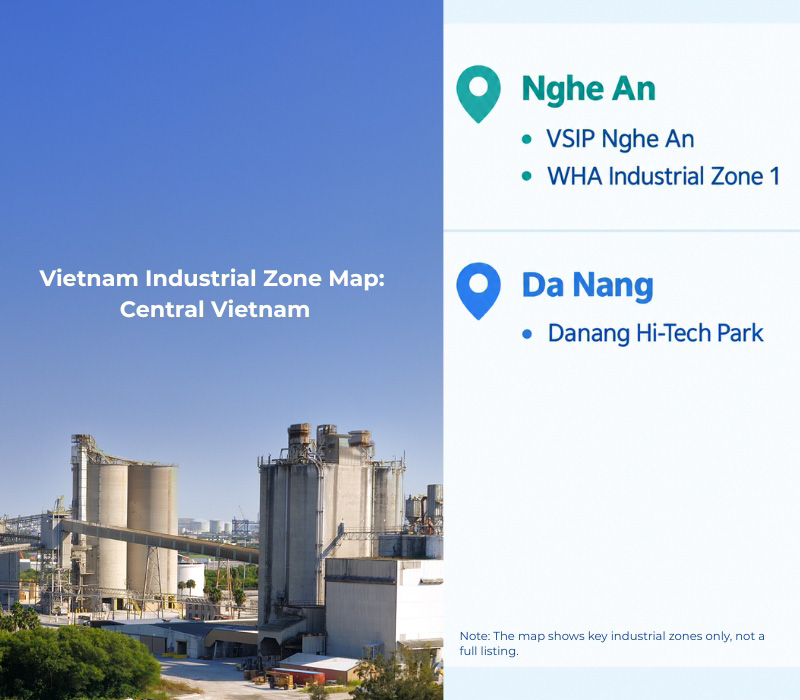
Vietnam industrial zone map: Central Vietnam
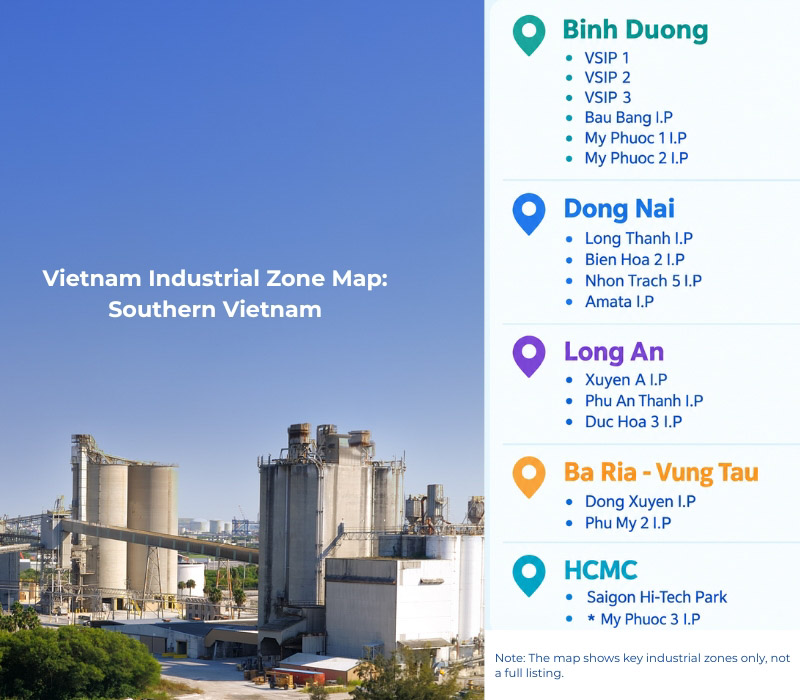
Vietnam industrial zone map: Southern Vietnam
Industrial parks in northern Vietnam
Key provinces
Northern Vietnam has developed a dense network of industrial parks around Hanoi and northeastern manufacturing centers. Bac Ninh is a prominent location, with industrial parks such as Yen Phong, VSIP, and Tien Son supporting its electronics and supporting-industry ecosystem.
In the first six months of 2026 alone, industrial parks in Bac Ninh attracted nearly USD 2 billion in FDI, bringing the total valid registered FDI capital to nearly USD 41 billion [4].
Hung Yen and Hai Phong continue to play important roles in the northern manufacturing and logistics network thanks to their connections to Hanoi, interregional transportation routes, and seaport systems. Hanoi benefits from its labor market, business support services, and connectivity with neighboring industrial provinces.
Why do investors choose northern Vietnam?
Northern Vietnam’s key advantage lies in its direct connections to electronics and high-tech manufacturing supply chains. Bac Ninh is currently pursuing a transition from a large-scale manufacturing and assembly hub to a high-tech industrial center, while developing its network of supporting-industry businesses and local suppliers [5].
Expressways and ring roads connecting Hanoi with Bac Ninh, Hung Yen, and Hai Phong help shorten transportation times between factories, warehouses, and seaports. For businesses seeking factory space for lease in Bac Ninh or factory space for lease in Yen Phong, industrial park locations should be evaluated alongside distances to suppliers, transportation routes, and labor markets rather than by rental rates alone.
Industrial parks in central Vietnam
Key provinces
Unlike the country’s two major industrial hubs, central Vietnam has developed industrial parks along economic corridors connected to urban centers, seaports, and economic zones. Da Nang, Quang Nam, and Thua Thien Hue are notable locations, with the Chu Lai area standing out for its integrated model connecting industrial parks, seaports, logistics, and airports.
Following the merger of Quang Nam into Da Nang, Chu Lai Open Economic Zone has become an important industrial area in the southern part of the city. The economic zone has 14 established industrial parks, of which seven are operational. It has attracted 165 projects with total registered investment exceeding VND 82 trillion [6].
Emerging opportunities
Chu Lai benefits from its seaport and airport systems, as well as available land for industrial development. The area’s latest development orientation continues to expand industrial park and logistics capacity, alongside mechanical engineering, automotive, and high-tech industries. For the 2026–2030 period, Chu Lai Open Economic Zone aims to attract approximately USD 5 billion in investment and bring at least five additional industrial parks into operation [7].
Da Nang is also planning to develop its southern area into a modern industrial and logistics center, with new projects in Chu Lai and port areas [8]. This creates a suitable foundation for industries that require substantial land, import-export connectivity, and more competitive premises costs than those in densely concentrated industrial hubs.
Industrial parks in southern Vietnam
Key provinces
Southern Vietnam has a large industrial park network concentrated around Ho Chi Minh City and the industrial centers of the southeastern region. Dong Nai stands out for areas such as Nhon Trach, Long Thanh, and Bien Hoa, while Binh Duong, Long An, and Ba Ria–Vung Tau serve as important manufacturing, logistics, and supporting-industry hubs.
Dong Nai is expanding its role from a traditional industrial center toward high-tech manufacturing and logistics. In the first seven months of 2026, the province attracted USD 1.57 billion in FDI, with investment concentrated in processing and manufacturing, supporting industries, and logistics [9].
Ba Ria–Vung Tau has distinct advantages thanks to the Cai Mep–Thi Vai deep-water port complex. The province previously had 15 industrial parks approved in principle for investment, of which 13 were operational, providing a foundation for manufacturing industries linked to import-export activities and logistics [10].
Why does southern Vietnam lead in FDI inflows?
Southern Vietnam’s advantages stem from the combination of a large market, an established industrial park system, and a multimodal logistics network. Dong Nai is developing transport connections to Ho Chi Minh City, seaports, and Long Thanh International Airport, while the Cai Mep–Thi Vai area offers additional options for businesses engaged in maritime import-export activities [11].
The high concentration of industrial parks also increases pressure on available land. Therefore, businesses seeking factory space for lease in Dong Nai, factory space for lease in Nhon Trach, or warehouse space for lease in Ho Chi Minh City should assess location, floor area, and logistics connectivity early rather than relying solely on rental prices. This is particularly important in areas with high occupancy rates that continue to attract new projects.
How to choose a suitable industrial park location
No single industrial park location suits every type of manufacturing operation. Businesses should begin by assessing their supply chains and actual operational requirements, then compare rental costs and incentive policies.
- Where is the labor force located? Is the industrial park near residential areas, urban centers, or training institutions to ensure a long-term labor supply?
- Where is the supply chain concentrated? Will distances to suppliers, customers, and manufacturing centers increase transportation costs?
- What tax incentives apply? Check the specific policies applicable to each locality, industry, industrial park, or economic zone rather than assuming every project qualifies for the same incentives.
- Is proximity to a seaport or airport necessary? Import-export businesses should factor transportation time, customs clearance capacity, and road connectivity into their total logistics costs.
For businesses seeking manufacturing premises or warehouse space across multiple locations, comparing these factors on an overview map of industrial zones in Vietnam can help narrow down the options before conducting on-site assessments. KTG Industrial can support businesses in finding suitable locations based on their requirements for location, floor area, and industrial property type.
KTG Industrial – Ready-built warehouse and factory solutions in Vietnam’s industrial parks
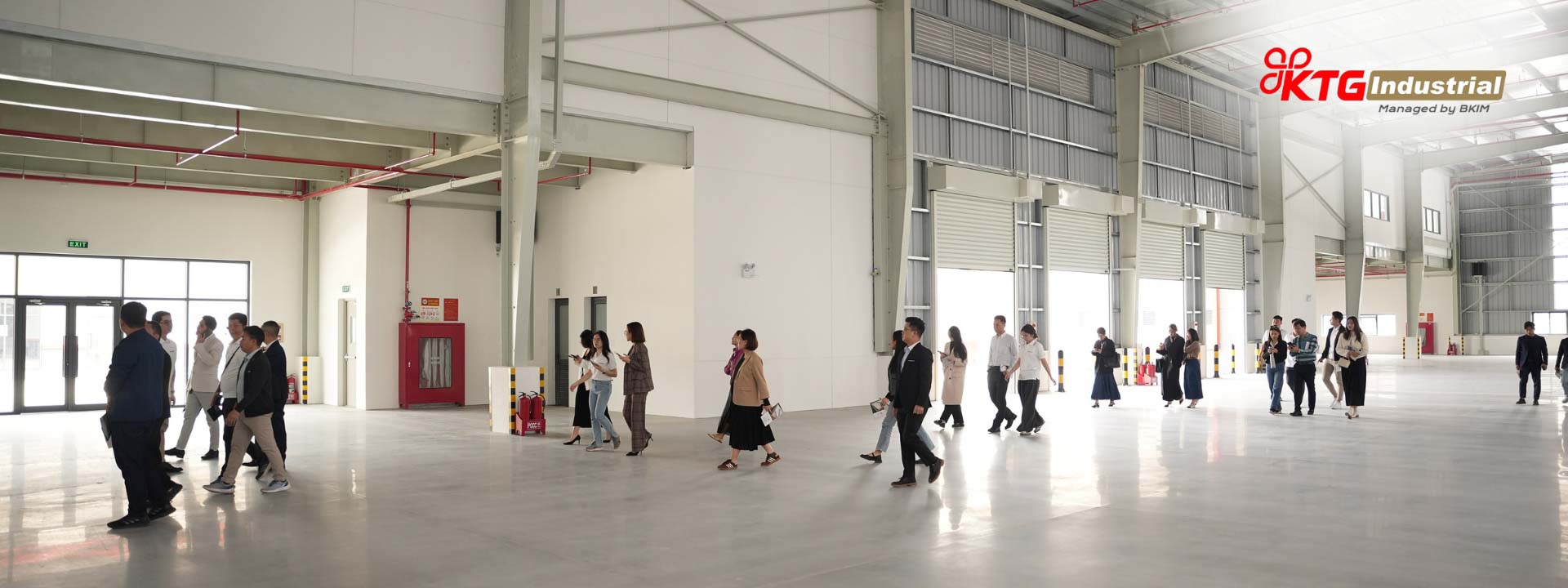
KTG Industrial provides ready-built warehouse and factory solutions in industrial parks with convenient locations and connections to transportation routes, logistics centers, and supply chains.
Through its Ready-Built Factory (RBF) and Ready-Built Warehouse (RBW) models, businesses can select spaces and floor areas that suit their manufacturing, storage, or expansion needs in Vietnam.
Projects are developed to meet requirements for functionality, construction standards, and operating environments for both domestic businesses and foreign investors.
With a portfolio of projects across multiple key industrial parks, KTG Industrial aims to provide flexible industrial spaces that help businesses shorten implementation timelines and gain greater control over their manufacturing and business development plans.
Frequently asked questions
How many industrial parks are there in Vietnam?
As of the end of 2025, Vietnam had 478 established industrial parks, covering a total natural land area of approximately 145,970 hectares. Of these, 324 industrial parks were operational [1].
Which province has the most industrial parks?
Dong Nai has previously been reported as the province with the largest number of industrial parks in the country, with 32 industrial parks and 36 industrial clusters. According to figures published in 2024, the province’s industrial parks had an occupancy rate of over 84% [12].
Where are Vietnam’s largest industrial parks located?
Large-scale industrial parks are concentrated in developed industrial regions such as southeastern Vietnam, the Red River Delta, and several coastal localities. For example, Dong Nai had 32 industrial parks, according to figures published by the Government News in 2024.
Beyond the scale of individual industrial parks, localities such as Dong Nai benefit from long-established industrial park networks and a strong ability to attract investment. Industrial parks in Dong Nai had attracted investors from more than 40 countries and territories, with total investment of approximately USD 37 billion at the time of reporting [12].
Conclusion
Vietnam’s industrial park map continues to expand along new manufacturing, logistics, and infrastructure corridors. For businesses, choosing a suitable location requires evaluating distances to suppliers, seaports, airports, and labor sources rather than focusing solely on rental costs.
References
[1] Industrial Agency Electronic Information Portal (via.gov.vn) (2026). Development trends of industrial parks in the new period.
https://via.gov.vn//tin-tuc/t24832/xu-huong-phat-trien-cac-khu-cong-nghiep-trong-giai-doan-moi
[2] Institute of Strategy and Financial Policy (2025). Vietnam’s industrial real estate market in 2025.
https://nief.mof.gov.vn/kinh-te-xa-hoi/tinh-hinh-bat-dong-san-khu-cong-nghiep-viet-nam-nam-2025-11620.html
[3] National Statistics Office Electronic Information Portal (www.nso.gov.vn). Manufacturing and processing attracts the largest share of foreign direct investment in 2025.
https://www.nso.gov.vn/tin-tuc-thong-ke/2026/01/nganh-cong-nghiep-che-bien-che-tao-thu-hut-manh-me-nhat-dong-von-dau-tu-truc-tiep-nuoc-ngoai-nam-2025/
[4] VietnamPlus (2026). Bac Ninh attracts nearly USD 2 billion in FDI in the first six months of the year.
https://www.vietnamplus.vn/tinh-bac-ninh-thu-hut-gan-2-ty-usd-von-fdi-trong-6-thang-dau-nam-post1120170.vnp
[5] Chinhphu.vn (2026). Bac Ninh accelerates its shift toward high-quality, sustainable growth. Government News.
https://baochinhphu.vn/bac-ninh-chuyen-manh-sang-tang-truong-chat-luong-cao-ben-vung-102260723165907056.htm
[6] Chinhphu.vn (2025). Establishment of the Management Board of Chu Lai Open Economic Zone in Da Nang City. Government News.
https://baochinhphu.vn/thanh-lap-ban-quan-ly-khu-kinh-te-mo-chu-lai-thanh-pho-da-nang-10225112815093735.htm
[7] Chinhphu.vn (2026). Da Nang’s southern growth region accelerates efforts to achieve double-digit growth. Government News.
https://baochinhphu.vn/vung-dong-luc-phia-nam-da-nang-tang-toc-thuc-hien-muc-tieu-tang-truong-hai-con-so-102260715164528331.htm
[8] Quang Ha (2026). Striving to disburse 100% of public investment capital in 2026. Da Nang City Electronic Information Portal.
https://danang.gov.vn/vi/web/dng/w/phan-dau-giai-ngan-100-von-dau-tu-cong-nam-2026
[9] Sy Tuyen (2026). Resolution 10-NQ/TW: A new wave of FDI flows into Dong Nai. VietnamPlus.
https://www.vietnamplus.vn/nghi-quyet-10-nqtw-von-fdi-the-he-moi-rot-manh-vao-dong-nai-post1128043.vnp
[10] Hoang Nhi (2025). Ba Ria–Vung Tau diversifies investment inflows into industrial parks. VietnamPlus.
https://www.vietnamplus.vn/ba-ria-vung-tau-thu-hut-da-dang-dong-von-dau-tu-vao-cac-khu-cong-nghiep-post1015117.vnp
[11] Chinhphu.vn (2026). Dong Nai reports on measures addressing traffic congestion concerns related to connections with Ho Chi Minh City. Government News.
https://baochinhphu.vn/dong-nai-bao-cao-ket-qua-xu-ly-thong-tin-phan-anh-tinh-trang-un-tac-giao-thong-tai-tp-dong-nai-ket-noi-tphcm-102261001164226108.htm
[12] Chinhphu.vn (2024). Prime Minister: Provincial planning helps Dong Nai connect, integrate, and take off. Government News.
https://baochinhphu.vn/thu-tuong-quy-hoach-tinh-giup-dong-nai-ket-noi-hoi-nhap-va-cat-canh-102240924124114108.htm