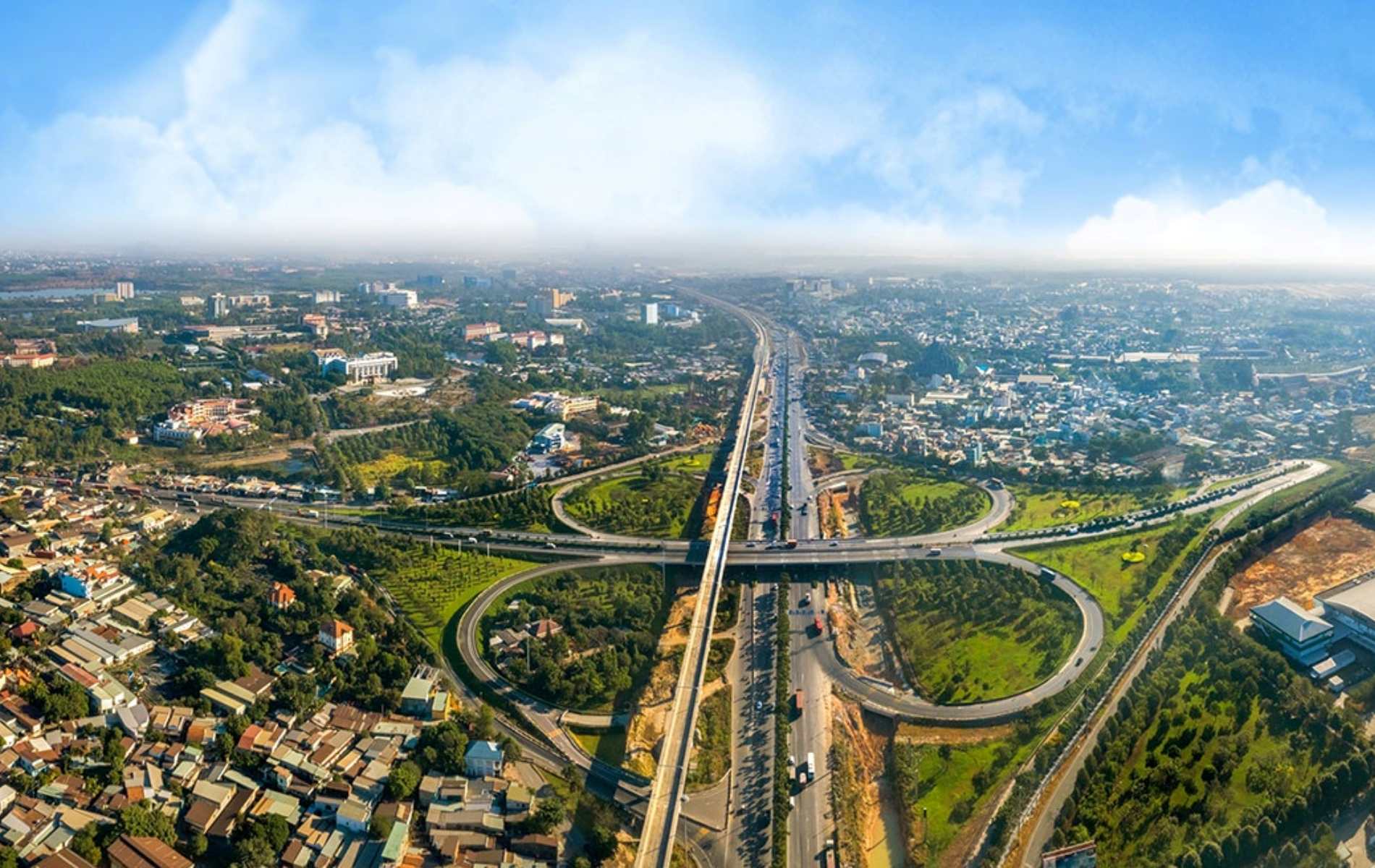


How can enterprises in Dong Nai continue to expand production while meeting Net Zero standards?
This is no longer a future scenario but a practical challenge related to energy and infrastructure today. Together with KTG Industrial, explore the trend of greening industrial production in the following article.
Dong Nai industry pioneers the Net Zero commitment
Dong Nai’s industrial sector is demonstrating a pioneering role in implementing Net Zero commitments through tangible development results.
In the first nine months of 2025, the industrial production index increased by 14.03%, and the trade balance recorded a trade surplus of USD 6.5 billion, reflecting recovery alongside improved growth quality.
At the same time, the industrial structure is gradually shifting from labor-intensive models to high-tech manufacturing and supporting industries, moving toward greater efficiency and sustainability.
A notable example of this trend is Amata Industrial Park, which has met approximately 86% of international eco-industrial park criteria.
Related article: KTG Industrial and a sustainable human resources strategy

Amata Industrial Park has achieved international standards
Key policy decisions linking production with environmental protection
In Dong Nai, recent policy decisions have set the objective of aligning production with environmental protection, adhering to the principle of not trading off the environment for economic growth.
Accordingly, the province focuses on promoting renewable energy and encouraging energy-efficient and effective use across IPs.
Under Power Development Plan VIII, rooftop solar power is oriented to reach a capacity of approximately 1,960 MW by 2030, supporting greener production.
At the same time, enterprises are facilitated to gradually reduce dependence on fossil energy and enhance on-site power self-sufficiency.
Room for modern industrial and logistics development
Dong Nai holds significant advantages in land reserves for industrial and logistics development, creating favorable conditions to advance modern production models.
According to planning orientations, the province has 81 IPs with a total area exceeding 39,000 hectares, alongside 63 industrial clusters distributed across key locations.
In addition to the existing system, the province continues to expand new subzones to strengthen its capacity to attract high-quality investment flows.
Notable examples include Phuoc An IP, planned as an eco-industrial park integrated with seaports and logistics hubs. At the same time, Long Duc 3, Xuan Que Song Nhan, and Bau Can Tan Hiep are being prepared for new industries, prioritizing semiconductors, chips, and clean technologies.

Dong Nai expands industrial parks, ready to attract logistics and clean technology investment
KTG Industrial green factory projects in Dong Nai
In Dong Nai, KTG Industrial is developing multiple ready-built factorie projects under a green-oriented approach, primarily located in Nhon Trach, Bien Hoa, and Long Thanh.
These projects are master planned in an integrated manner, meet LEED standards, and incorporate energy-saving solutions and emission control from the design and operation stages.
A key highlight is KTG Industrial Nhon Trach 2, spanning phases 1 to 4, offering a wide range of floor areas suitable for different production models.
In addition, projects in Tam Phuoc and An Phuoc are positioned in areas with strong transportation and logistics connectivity.
Overall, the developments emphasize rooftop solar power, efficient lighting and ventilation systems, international-standard fire protection, high-load industrial flooring, and industrial green spaces, helping enterprises move closer to green factory models and sustainable production.

KTG Industrial Nhon Trach 2 project in Dong Nai
Administrative reform as a foundation supporting green business growth
Administrative reform is increasingly becoming a foundational pillar supporting enterprises in their pursuit of green growth.
The “borderless administrative procedures” model has been implemented, enabling more flexible submission and processing of documents without dependence on administrative boundaries.
As a result, Dong Nai ranks second among 34 provinces and cities in the index of services for citizens and businesses.
At the same time, digital transformation has been strongly promoted, with approximately 88% of applications processed online and 99.29% resolved on time, contributing to shorter project implementation timelines and a more transparent and favorable investment environment.
Conclusion
Greening industrial production in Dong Nai toward Net Zero is gradually becoming an inevitable direction rather than a strategic option.
Within this transition, early investment in green factories, the use of renewable energy, and efficient operations will enable enterprises to enhance competitiveness while contributing to long-term sustainable development goals.
References
Thien Vuong (2025). Dong Nai quyet liet hanh dong “xanh hoa” san xuat cong nghiep. Bao Nhan Dan.
https://nhandan.vn/dong-nai-quyet-liet-hanh-dong-xanh-hoa-san-xuat-cong-nghiep-post919212.html